


This is a much delayed second part of a three part series on my sustainability practice. The series was inspired by internal debates and conversations I was having about the struggle of living sustainably. If its even possible in our modern society and how to integrate sustainability into decision making.
If you’re new here, it's worth checking out the post “Sustainable choices and tough questions” that kicked off the series which gives the three principles of my sustainability practice;
Choose local
Don’t beat yourself up in the process
This article tackles tip number two for living a tiny bit more sustainably without losing your mind: choosing local in our incredibly globalized world.

I have been putting off writing about principle #2, not because I don’t believe it, but because I have not exactly been living true to it lately. This year I have had the opportunity to head to some pretty incredible events around the world as part of my role at the Innovation Alliance for a Global Plastics Treaty and with Plastic Odyssey. I was at the UN Oceans Conference in Nice, France in July, the plastic treaty negotiation session in Geneva, Switzerland in August, New York for Climate Week in September and Istanbul, Türkiye for the Zero Waste Forum in October.
On the one hand, my head spins to think that I get to attend these prestigious events, and not only as an audience member, but as a presenter (look, Mom, I’ve made it!). On the other hand, I slide into guilt thinking about the impact of all these trips (and whether they are truly worth it?!).
So I write this post with full transparency that I have not been practicing what I preach (though I never wanted this to be preachy).
What ‘Choose Local’ means to me
The main idea behind choosing local is that, in general, shorter supply chains tend to be more sustainable. Products that travel longer distances lead to greater transport emissions, if they are perishable, they require refrigeration or freezing which adds to its environmental impact, and the more steps along the chain, the less likely there is effective monitoring and transparency. The closer we are to the farms, people and factories making our food and products, the easier it is to see and monitor the impacts, and the harder it is to ignore them.
Choosing local could mean:
Buying fruits and vegetables at farmer’s markets or through community supported agriculture (CSA) programs
Going on a staycation to a nature area in your area instead of flying on a city trip
Taking note of seasonal produce and buying within season
Getting your bread, milk, eggs, cheese etc. from local producers
Taking a train vacation instead of distant flight
Getting clothes from your neighborhood second hand store
Taking your ripped jeans to your local tailor to get them fixed
Buying gifts at a local boutique
Of course… local does not always mean ‘low impact’. A tomato grown in a heated Dutch greenhouse in winter can have a higher footprint than one shipped from Spain (see some LCA studies here and here). But as a general rule of thumb, buying local builds the kind of awareness and connection that sustainability requires.
The anti-Amazon economy
What you may notice about almost all of my tips above (some of which I clearly struggle to live by!), is that they involve a little bit of work and are more place-based. Many of them involve having to physically bring yourself to a location to buy or fix something instead of ordering online. This is one of the main ethos behind this principle and a bit of a psychological trick. I know I’m a sucker for an impulse buy, which is harder when you are forced to walk to the store, find the item and decide if you need it. Sure, you may end up buying even more things on a trip to the store, but you are also supporting a local business in the process.
The convenience creep
I’m terrified of the convenience economy and how quickly it has become the norm. How easy it is to order random things online knowing you can easily return them (which is dangerous, as most items may never reach another consumer). But e-commerce also makes economic sense: you want an ice cream scooper for a party, you find the best reviewed one online, see it can be delivered by tomorrow and it’s cheaper than what you can find in the store... its a no brainer!
But I’m suggesting to see it differently sometimes. Ordering online means no human interaction necessary, it means the beautiful neighborhood kitchen store is not getting any business, and it can contribute to a sense of overconsumption that is overwhelming society. Perhaps the burden of going to the store means you give up and don’t end up buying the ice cream scoop (big spoon for the win!). Or perhaps you go, have a nice chat with the shopkeeper and end up buying the scoop and some reusable silicone food storage bags. Now you’ve supported the local economy and eliminated your use of single use plastic bags. Double-win!
In defense of community
This holds true for your local bookshop, toy store, clothing boutique, tailor, hardware store, speciality food market etc. These shops may be more expensive than ordering online, and there is no guarantee you’ll find what you need. But taking the time and putting money into your community stores creates rewards through relationships, appreciation and protection of brick and mortar stores. My aunt has a toy store in Manhattan in New York City, I’ve grown up visiting that store and the smell upon entering is instant nostalgia. During COVID, it was unclear if the store would survive. It did, mainly thanks to e-commerce, but now I cherish the opportunities when I get to visit the shop (its called Kidding Around, in case you find yourself in NYC). I know the staff truly wants to help you find the best toy for your niece or gift for your best friend’s baby shower, and that kind of service.. well you can’t get it on Amazon.
The complicated math
By spending money at local shops instead of at big online retailers, you may also be shopping more sustainably. Instead of one delivery box for one gadget to your house, it is bulk delivery to the store, saving transport emissions and packaging. While writing this, I did a deep dive into the sustainability comparison between e-commerce and brick-and-mortar retail. The results are mixed, depending on product type, transport efficiency, and return rates. Some analyses, suggest that online shopping has lower impact when done efficiently. Others, highlight that delivery, packaging waste, and overconsumption can negate those benefits. Sustainability decisions are complex, but I stand firm in my belief in supporting community!


Rediscovering home
There’s a great ad I’ve seen around Amsterdam for a website that allows you to book a house in nature (the company is literally called “NatureHouse” in Dutch). The ad says “not flying, but still landing” which I love. Its clever and it reminds me of what many of us learned during COVID lockdown - there are plenty of places in our own backyards to explore.
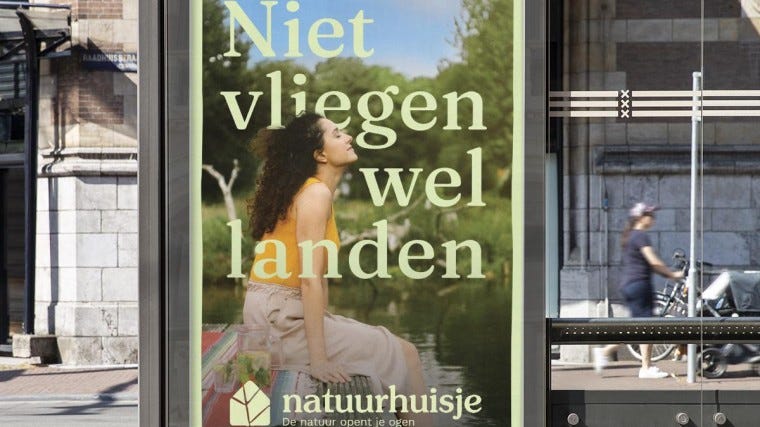
There are many exciting exotic vacation destinations (and I’ve done more than my fair share of world travel), but there are also incredible places in our neighborhoods, cities, countries and regions. Not only is staying local better for the environment, it is also better for our sense of community and belonging. When you explore your home, you may find yourself developing newfound appreciation or re-energizing your hometown pride.
In the Netherlands, there is an area called the Veluwe; rugged dunes, wind swept trees, forests. This national park is one of my favorite places to visit in the Netherlands, it feels wild but accessible. The park has hundreds of white bikes parked at each entrance, when you enter, you grab one, adjust the seat and head off. If you stop at a cafe or museum, you drop the bike (unlocked), knowing that with the ebbs and flows of crowds, there should be a different one waiting for you. The park houses a famous art museum (the Kröller-Müller), several different ecosystems, walking paths and of course a pancake house. Visiting with my mom has been a highlight of my time in the Netherlands, and one of my strongest memories with her despite the fact that we have traveled all over the world together. Perhaps because showing her this beautiful nature site in the Netherlands was a source of pride - this was my new backyard!


Small choices, big ripples
Choosing local won’t fix the climate crisis, but it changes the way we participate in it. Every purchase or trip is also a vote with our dollars and our time for the products and places that we cherish. These tiny daily choices can coalesce into meaningful impact for our communities.
When I get overwhelmed by the state of our planet, I walk to my favorite local cafe, order an oat milk cappuccino from the barista that I recognize, shop for vegetables at the market down the street, and resist yet another Instagram ad for sustainable sneakers. These small choices feel like tiny acts of resistance against convenience and distance in favor of connection and community, and I feel much better afterwards. Maybe you will too.

A wonderful reminder that our actions have an impact beyond the one we may be targeting, sharing a smile with a new mother, sharing your love of the fresh smell of basil with the other shopper whose eye you just caught. We are reminded that we have a community and it is our job to nourish and protect it.
Thank you for reminding us to stop and make thoughtful choices.
Small actions add up!