


If you run in any of the same professional circles as I do, then your LinkedIn has been absolutely inundated with events, pictures, recaps and posts about being ‘grateful’, ‘delighted’, ‘pleased’ or ‘energized’ to have been at UNOC. It has been a deluge and I have been scrolling frantically, desperate to see something other than groups of lanyard-ed people in front of blue backdrops.
I wanted to add one of my own. I spoke on a panel, joined an epic paddle-board and swim session and indeed met many amazing people and organizations. But it felt like tossing out another generic post into a river of other posts. I thought I could add some ‘hot takes’ to make it stand out, but I’m not sure any of my takes would be hot, and I genuinely enjoyed the conference for the most part.
So I decided to write an honest account of what it was like to attend the biggest gathering of ocean enthusiasts, advocates, professionals and government representatives happening this year: the UN Oceans Conference.
Some of you may be reading this and have no idea what I’m talking about, which is super interesting! We live and work in siloes and don’t often realize how much of our environment is an echo chamber. If you are curious what the heck a big UN conference is, what the purpose is, why so many people make a huge effort to go and what actually comes out of it, I’ll also give you some answers (as much as I can make sense of it myself). So stick around!
What is the UN Oceans Conference?
The UN Oceans Conference or UNOC - pronounced you-knock by most of us - is a high level event by the United Nations organized to support implementation of Sustainable Development Goal 14 (SDG 14) to "Conserve and sustainably use the oceans, seas and marine resources for sustainable development.”
The United Nations is like the government of countries, and has a general assembly where all nations who are members of the UN discuss international politics and issues. The UN also has topic-specific conferences like the climate conference of the parties (COP) and international treaties and meetings to govern the world.
What was missing was the ocean, which covers 70% of the world and touches basically every single sector and is interconnected and global. Thus, the UN Oceans Conference was born in 2017, held in New York City and hosted by Fiji and Sweden (I know, complicated). It is supposed to happen every three years, but due to a long pause for COVID, last week was the third, hosted in Nice, France by the governments of France and Costa Rica.
How is UNOC organized?
Good question, hard to answer. This year the general vibe before the conference was uncertainty, around who was going, what type of events would be happening and which types of organizations would attend. In practice, at least for this year, the conference was organized into zones. The blue zone was the government focused assembly areas, for official, high-security events, panels and debates. The green zone was hosted in a large convention center, was open to the public and consisted of different pavilions to explore and hundreds of shorter events and panels to attend. Then, the rest of Nice was open season, there were official (and unofficial) side events happening in hotels, in parks and at beach clubs. Sound simple enough? Well, throw in 25-minute walks between zones in Mediterranean sun, delegates in suits and ties, long security lines, and back-to-back events Oh yeah, and there were also boats (big boats). The week was busy, sweaty and at-times, frustrating. More on that later!


Who goes to UNOC and why?
The conference has become a massive event. Government representatives (called delegates in UN speak), non-profits, advocacy groups, philanthropists, businesses, startups and scientists all gather to discuss ocean issues. It has become a sort of ‘who’s who’ in the ocean conservation world, and in the run-up to the event I noticed people slipping into conversation that they were ‘headed to Nice’ or ‘ busy preparing for UNOC’ (and I was guilty of doing the same!).
For government delegates, its a forum to participate in international debate, make commitments, encourage action and support momentum. For NGOs and advocacy groups its an opportunity to speak with governments, identify partners and present work. For startups and businesses, they can meet potential collaborators or investors, and advertise their innovations on a global stage. For scientists, its a chance to update key players on the latest science, and ideally bridge the science-policy gap. For everyone, its as place to meet like-minded people doing pretty amazing work and hear the latest updates on ocean issues, campaigns, challenges and wins.
My experience at UNOC 2025
So how did little ol’ me end up at the biggest Ocean conference of the year? Good question! I had heard amazing things about UNOC ever since the 2022 conference in Portugal, and thought it could be a good opportunity for me to present some of my latest research and hear more about the latest ocean conservation work. I’ve always been an ocean-lover, and though my work doesn’t always directly focus on the marine environment, my work on plastic has always hoped to reduce waste which in turn reduces waste in the ocean. I had two papers recently published, with results from a monitoring and cleanup expedition to Henderson Island (more blog posts on this soon), and I was hoping to find a place to talk about them.
Applying and deciding
Most people who go to UNOC do so attached to a company or organization that are presenting or hosting in some way, be it an networking session on a boat, an invited panelist or co-hosting an event. Luckily, I have some good friends in the ocean space, and as the buzz around UNOC grew, we decided to submit an ‘official side-event’ on storytelling and ocean conservation. The submission was relatively easy, we sent it off in the nick of time, and sat to wait, and wait, and wait….
This is where the frustration set in, we had submitted an event, but received no news from anyone for days, weeks, months. The conference was a few short months away, and we still didn’t hear anything. It felt a bit silly to attend the conference as a bystander, without an event or panel to join, but the lack of information and communication stifled many from making plans or commitments. As the days passed, the prices of flights rose and the airbnb options dwindled… The questions bubbled up. Are we going to be accepted? If so, where can we host our event? Should we go regardless? Who else is going? Argh!
We finally heard we were accepted, with 28 short days until the conference. Scrambling ensued. Luckily, Ally Dragozet of Sea Going Green (a co-organizer who happens to be one of my best friends), is incredibly well connected and managed to wrangle a spot at a hotel for an hour to host our event through partners. To be honest, I have no idea how we would have found a spot otherwise!
Getting ready and getting to Nice
So we were officially going! Airbnb and flights were hastily booked. We chased down co-organizers to confirm their commitment, budget, and logistics, and to start sharing information about our event. We were going, but we had no idea who else would, and if they would show up at our event (and if it would all be worth it!). At this point, the anticipation was growing, and my LinkedIn was constantly peppered with people sharing events and invitations for UNOC panels and side events. I was getting excited, mostly because some friends and mentors would be there, and it would be chance to reunite or meet in person for the first time. Since it is a UN event, there were different forms and security clearances to get, and Ally was once again a lifesaver offering her organization’s accreditation. Accreditation is an official UN approval of your organization’s legitimacy, and is a necessary prerequisite for UN conferences and can be used for up to five people.
The whirlwind week
Ally and I arrived to Nice on Monday, when the conference was already in full swing. The week before UNOC was a scientific conference and the weekend before was the Blue Economy Finance Forum (BEFF), up the coast in Monaco. So ocean people had already descended on Nice and the city was bustling with lanyard and suit wearing attendees, locals and tourists alike. The city was fizzing with energy! It is honestly hard for me to remember which events I went to and when, the days have melted together in the summer heat. Some memorable moments below
La Baleine and the Green Zone
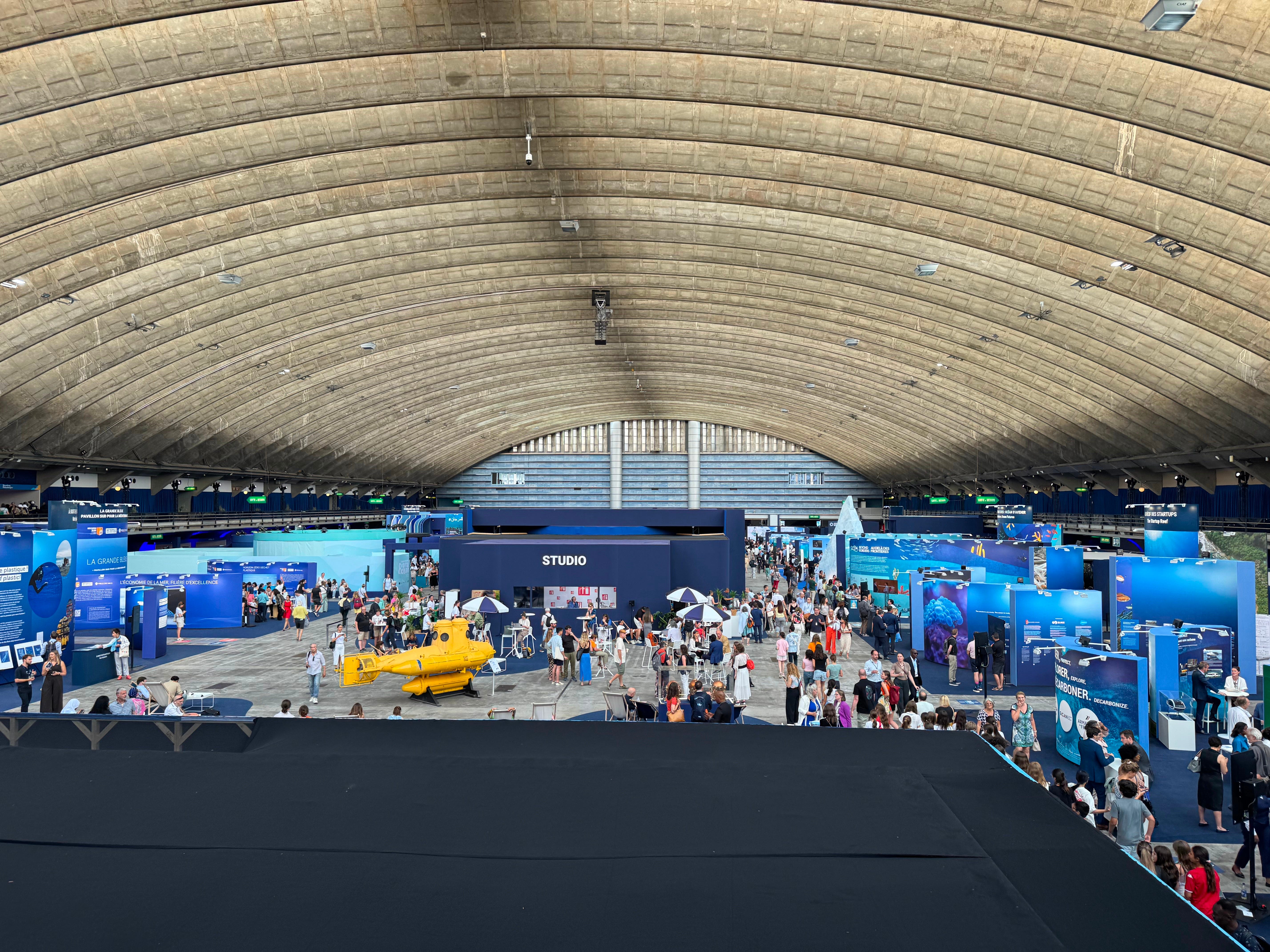
La Baleine - aka the whale - was an impressive conference center transformed into all things ocean. There were different pavilions representing themes, ecosystems, focus areas like the ‘Startup Reef’ or ‘Out of Plastic’ pavilion, there was immersive art, giant photos of whales and arctic VR experiences. It was packed with children and visitors practically every day and was my favorite place during UNOC. I got to meet up with the Plastic Odyssey team (and see myself on the wall of the plastic pavilion!) and there was always something interesting happening. Highlights included Plastic Odyssey’s UNESCO partnership presentation, a VR penguin experience and watching inspiring startup pitches.
UN official events at the Blue Zone
The Blue Zone comprised of giant (poorly) air conditioned tents along Port Lympia in Nice, full of official looking tables and chairs. If you’ve ever seen UN meetings, where each country has its own table, small sign, microphone and translation devices, imagine that, but in a temporary tent along a Mediterranean harbor. Quite a feat! There were a lot of fences and security to get in, and walking between tents was sweltering. I joined a few sessions, but I found the experience so uninspiring compared to the Green Zone, that I spent practically no time there. A bit strange to go to a UN conference and spend hardly any time at the official UN site, but there was always a side event or panel calling my name from a more inspiring location…
Side events and swimming
Side events were the cherry on top of the week. They were sprinkled throughout the city, requiring walking, trains, trams, or, in one desperate attempt when I was already late…hitchhiking. There were morning swims, evening parties, movie screenings and panels. I was lucky enough to join Protect Blue’s Wave Break event, which was a morning paddleboard and swim among the seagrass. Linzi delivered a beautiful acknowledgement of place at Villefranche (who knew that right off the beach the seafloor dropped so steeply you could fit an eiffel tower underwater) and Luke snapped epic pictures of us frolicking among the healthy poseidonia. A necessary reminder of why we all work so hard to protect this salty haven! I also joined the ‘Ocean Reels and Real Talk’ panel with Ally, presenting work from C-Faarer, alongside films from Plastic Odyssey, The Blue Quest, IN DEPTH Films and the International Ocean Film Festival. I was super nervous but the audience was engaged, asked great questions, loved our films and shared a needed glass of wine after. However the reality of the city spread and double booked agendas (and rumor has it, over 1,000 events) meant you had to make some tough choices, which brings me to:


FOMO and missed opportunities
I HAD SO MUCH FOMO. It was a sad reality that it would be impossible to attend all the events, see all the people, swim in all the beaches. In a twist of bad luck, my friend Ricky had a side event that happened to be booked at the exact same time as ours. There was a beach club that had been transformed into ‘Ocean House’ that was just a bit too far and I never made it, which I’m still kicking myself for. There were friends I didn’t catch, conversations I wanted to have and deep breaths I should have taken. I think I maybe could have (should have?) spent more time at the actual UN debates, instead of reading about the summaries and other’s rundowns of the days events. I followed closely the The Nice wake up call for an ambitious plastics treaty (signed by 95 countries!) but I can’t say I did any direct advocacy during my time in France. Things to consider for next time… I left with a long list of interesting people to follow up with, a phone full of selfies with friends new and old and a feeling of hope that there are so many dedicated people working on ocean conservation.


Final thoughts
For those who didn’t attend (or had no idea what it was), the idea of a big UN conference may seem professional, stuffy and well-organized, in fact it was often chaotic, energetic and dynamic. That being said, I’m sure official government delegates, who were stuck in the Blue Zone, had a very different experience than I did. In any case, I hope this behind-the-scenes honest account sheds some light into the reality of attending UNOC. Perhaps it makes you want to join, perhaps you will happily skip and maybe in three years when you see the next UNOC posts begin to appear on LinkedIn, you’ll have a slightly better idea of what goes on at this type of thing.


Ha, I concur with the FOMO and the sweaty missions from one spot to another. Let's pray someone makes an app for the next one.
Love the pics by Luke!